

You may not think of your digital footprint often. But we rely on digital data in multiple ways every day. Here’s an example. Last month, my wife and I were traveling to the Black Hills. I asked her to find a restaurant to grab lunch at on the way. She found a small hole-in-the-wall brunch spot on Google. When we arrived, we found a paper sign on the door. The brunch spot had been closed for months. And although there was a new restaurant that took its place, it was a diner that opened at 4pm. The business did not update its Google listing.
That memory keeps coming back to me, weirdly, because I think it’s a decent stand-in for what’s happening to a lot of businesses right now in a much bigger way. Someone searches for you. The information they find is wrong, or stale, or contradicts itself across different platforms. They move on. You never know.
The difference now versus even two years ago is that the stakes of that stale information are higher. A customer who notices the wrong hours on your site feels annoyed. An AI system that finds contradictory or missing information across your profiles might just leave you out of the answer entirely. Or worse, include you with the wrong details and present them as fact.
It’s past time to pay attention to AI queries about your business

I work in digital marketing, specifically focused on helping businesses show up when people search for them online (both through paid ads and organic search results). Watching what AI has done to search over the last couple of years has been genuinely disorienting in ways I didn’t fully expect. Google’s AI Overviews now reach over 2.5 billion monthly users. Researchers have described it as arguably the most widely encountered AI deployment in history (SQ Magazine). Pew Research Center found that about half of American adults are using AI chat bots now. This is up from a third in 2024. And six in ten read an AI-generated summary before they look at anything else in their search results.
Whether that’s good or bad for any given business depends almost entirely on what AI finds when it goes looking for them.
Know what informs AI search results
Semrush published a breakdown of how AI systems actually source their information. I recommend reading it if you want the full picture. The short version: it pulls from training data (which includes your website, Wikipedia, industry blogs, publications), live retrieval from Google and Bing’s search indexes, formal licensing agreements with certain platforms and direct user-uploaded content.
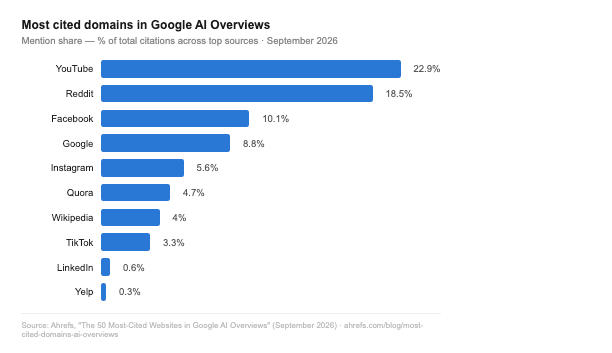
That last one is worth understanding. AI companies don’t just crawl the open web. They also pay certain platforms for the right to use their content directly. OpenAI has paid deals with Reddit, Yelp, Stack Overflow, and Time magazine, among others. That means when someone asks ChatGPT a question, it’s not just searching the internet, it’s drawing from a curated pool that includes everything on those platforms. This includes your Yelp reviews and a Reddit thread where someone mentioned your business, for examples. All of that is fair game as source material for an AI answer. It’s not just as a page someone might click on from their AI query, but they actually inform what AI says about you.
So, be sure that these key sites represent your business (if appropriate) and that your digital footprint of information is correct.
To influence AI, start with your website
Before we get into the broader digital footprint, let’s start with your website. Your website is still the foundation everything else cited in AI is built on.
57% of desktop visitors never scroll past the first thing they see (Flint). They land, they look, they decide. So what you put at the top matters — what you do, who it’s for, what they should do next. If those aren’t obvious immediately, most people are already gone.
In my experience, specific language tends to do better than vague language here. Here’s an example. “We help small businesses manage cash flow” is easier to understand and easier for AI to match to a relevant search compared to “We deliver innovative financial solutions.” Whether that holds across every industry, I can’t say for certain. But it comes up enough that it’s worth looking at your own homepage with fresh eyes.
There’s no better time to clean-up business directories
The harder problem — and this is the one I see more often — is businesses that have a decent website but an inconsistent or neglected presence everywhere else. As the term “digital footprint” implies a journey, make sure all the places you’ve been are clean and correct.
Google your own business name sometime and actually look at what comes up. Review the whole first page (your Google Business Profile, any Yelp or directory listings, your social media accounts, any forum threads or mentions). That’s what AI sees when it goes to build an answer about you. And if your hours are wrong on one platform, your address is slightly different on another, your description doesn’t match your website… those inconsistencies erode AI’s confidence in recommending you. In some cases, they can lead to AI getting basic facts about you wrong but presenting them confidently to someone who asked.
The fix for this is genuinely not glamorous. It’s going through your profiles and making sure everything matches. Fully fill out your Google Business Profile: categories, attributes, hours, photos, all of it. Build a presence on the platforms your customers actually use, whether that’s Yelp, LinkedIn, Facebook, or industry-specific directories. The more places you show up with consistent, accurate information, the clearer the picture AI can form.
I’ll admit I can’t tell you exactly how much weight any individual platform gets- that’s one of those things that varies by industry and changes over time. But the principle holds: more consistent signals across more credible sources generally means better AI visibility.
AI wants real thoughts from real people
Reviews are something most businesses treat as a reputation management task — something to check in on, respond to occasionally, try to accumulate more of when things get slow. In the context of AI, they’re something different.
Semrush found that AI builds its understanding of a brand from everything it finds across the internet, and reviews are a significant part of that picture. A detailed review that describes a real experience, names a specific person, mentions a specific outcome. This is the kind of content AI can pull from when someone asks about you. A hundred five-star ratings with no text attached isn’t that impactful.
The same applies to any content you put out. AI tends to surface things written by real people with a real point of view over content that’s polished but generic. That’s actually an advantage for smaller businesses who are willing to be specific and honest, because that’s exactly what both customers and AI are looking for. A genuine human perspective, at this point, is a competitive advantage.
Your job is to do the hard work for AI
Here’s the thing I keep coming back to: most of what I’ve described isn’t technically difficult. It’s not expensive. Updating your profiles, getting consistent, writing something honest and specific, asking your best customers to leave a detailed review. The barrier is usually time and attention. Businesses are busy and this stuff doesn’t feel urgent until someone tells them an AI got their hours wrong or described their services inaccurately to a potential customer.
If you want a quick gut check, find someone who has no idea who you are and ask them to spend a couple minutes looking up your business. Then, ask them what you do, who you serve, and what they’d do next. What they find (and what confuses them) is probably a reasonable approximation of what AI finds too.
If you’re not sure where to start, here are three things any business can do right now to optimize your digital footprint and build a stronger AI profile:
- Google yourself and fix what’s wrong. Check every result on the first page. Outdated hours, wrong address, missing description — fix it. Consistency across platforms is one of the clearest signals AI uses to understand and recommend you.
- Ask your best customers to leave a detailed review. Not just a star rating — a few sentences about who helped them, what they experienced, what made it worth it. That’s the kind of content AI actually pulls from.
- Make your website content clear about what you do and who you serve. Be specific. Vague language like “innovative solutions” doesn’t help a potential customer understand you — and it doesn’t help AI recommend you either. The more clearly your site describes what you actually offer, the better your chances of showing up when someone searches for it.
